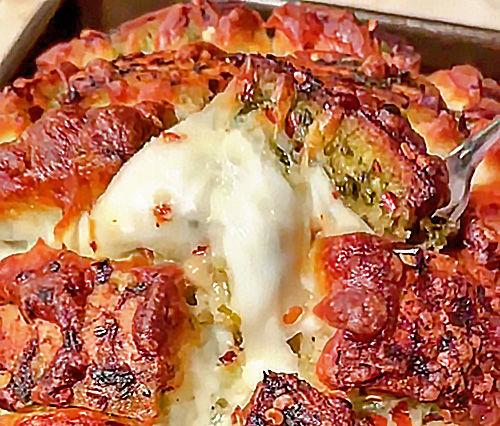
This recipe is an absolute must-try. It is the perfect accompaniment to a traditional main dish, such as spaghetti Bolognese, or nontraditional, such as braised pork chops.
Whichever route you choose, this stuffed bread is sure to be a crowd pleaser.
The soft, buttery inside with the crunchy, cheesy outside is a well-balanced combination. The garlicky pesto adds an extra layer of flavor, while the crushed red pepper brings the right amount of heat.
This recipe requires a bit of prep time, but it is super simple and easy to follow. Marina sauce can be a substitute for the pesto, if you prefer red sauce, and the mozzarella can always be replaced with something heavier like a smoked Gouda. The beauty of this recipe is that it can satisfy any taste buds!
Stuffed Pesto Bread
Ingredients
1 sourdough boule
1 stick of unsalted butter
2 cups shredded mozzarella
4 tbsp pesto
2 tbsp minced garlic
1/2 tsp crushed red pepper
1/4 tsp sea salt
1/8 tsp ground black pepper
Extra virgin olive oil
Directions
Preheat oven to 350 degrees.
Cut boule into a grid pattern, with incisions deep enough to stuff with cheese.
In a saucepan on medium low heat, add butter and garlic and stir until butter is melted.
Reduce heat. Add pesto, red pepper, sea salt, and black pepper. Stir until all ingredients are well incorporated into butter.
Pour mixture evenly over boule, allowing it to seep into the bread. Stuff the incisions evenly with mozzarella cheese. Top with olive oil drizzle.
Bake for 20-25 minutes, or until top is crunchy and brown. Serve immediately.
“The New Way to Cake” by Benjamina Ebuehi. (Courtesy Amazon/TNS)
Benjamina Ebuehi grew up in a Nigerian family in London, and her interest in cooking began when her mother bought her a child’s baking book.
As she continued to learn and work her way through other cookbooks, she says it was always the chapters on cakes that interested her the most. She began to create her own cake recipes, gravitating toward “putting flavors at the forefront without overshadowing them with excessive decoration.”
Her passion for baking led to an appearance on “The Great British Bake Off” in 2016, where she created a white chocolate and salted praline cake for the show’s Cake Week.
Now she has a cookbook, “The New Way to Cake,” which features her stripped-down, flavor-forward recipes.
Ebuehi’s vegan version of banana bread includes peanut butter for what she calls a “sweet-and-salty contrast.” She says her favorite way to eat this is “lightly toasted to crisp up the edges, with a generous spread of salted butter.”
PEANUT BUTTER BANANA BREAD
I believe that a good banana bread should be part of every baker’s repertoire. This version happens to be vegan, which was by no means intentional. I do think this tastes better the next day (if it can last that long), as it gives the flavors time to mingle with each other.
Advertisement
Makes 6-8 servings
4 small ripe bananas, divided
3 tablespoons smooth peanut butter
1/2 cup vegetable oil
5 tablespoons almond or soy milk
1 teaspoon vanilla extract
2 cups (300 grams) all-purpose flour
3/4 cup (175 grams) light brown sugar
2 teaspoons baking powder
1/2 teaspoon cinnamon
Pinch of salt
Preheat the oven to 350 degrees. Grease a 2-pound loaf pan and line the bottom with parchment paper.
In a large bowl, use a fork to mash 3 bananas. Mix in the peanut butter, oil, milk and vanilla and set aside. In a separate bowl, whisk together the flour, sugar, baking powder, cinnamon and salt. Pour the banana mixture into the dry ingredients and stir gently until just combined.
Slice the remaining banana in half lengthwise. Pour the batter into the loaf pan and gently place the sliced banana on top without overlapping the slices or pushing them into the batter. Bake for 45 to 50 minutes, or until well risen and a toothpick inserted into the center comes out clean. Leave to cool completely before slicing.
Tip: For some added texture, use a crunchy peanut butter instead of smooth or fold in chopped, roasted peanuts before baking.
Reprinted with permission from “The New Way to Cake” by Benjamina Ebuehi, Page Street Publishing Co.
Gerald Elias’ letter “Have our bread” of Dec. 19 voices his concerns regarding scarcities of food and the supply and cost of bread. Mr. Elias suggests that these problems can be solved by “supporting HR763, the bipartisan Energy Innovation and Carbon Dividend Act.” I share Mr. Elias’ concerns for people not having enough to eat, but HR763 will not solve the problem.
Contrary to Mr. Elias’ claim, HR763 is not bipartisan. HR763 has 67 sponsors in the House of Representatives; 66 are Democrats and one is a Republican. HR763 seeks to destroy the petroleum industry through taxation. HR763 would impose additional taxes on oil, gas and coal and those taxes would increase each year. HR763 would also increase the cost of gasoline for our vehicles, heat for our homes and the cost of producing our food.
The world’s food supply is dependent on petroleum. Massive amounts of oil and gas are used in the manufacture of fertilizers and pesticides, and in the planting, irrigation, cultivating, harvesting, processing and transporting food to the consumer. Petroleum takes much of the back breaking work out of farming and makes farms more productive. Ask farmers if they can continue their farming operations without petroleum.
HR763 is a Trojan horse designed to destroy the petroleum industry. It will reduce the food supply and make food more expensive.
Improving the flavor of barley used to make whiskey and finding new varieties for farmers to grow are some of the goals of a new fellowship that will begin next summer at Washington State University’s Bread Lab west of Burlington.
Bread Lab Director Stephen Jones said Seattle’s Westland Distillery, which makes single-malt whiskey, will fund a full-time Ph.D student at the Bread Lab for four years.
The student will focus on developing unique flavors of barley that can be grown by Skagit Valley farmers, Jones said.
“This is one the of the best places in the world to grow barley,” he said. “Barley likes it cool and wet. And you get flavors you wouldn’t get elsewhere.”
For years, Skagit Valley farmers have planted barley in their fields to improve soil health. In recent years they have grown it for profit, too, because of increasing demand from distilleries and other processors.